
TDR vs microwave moisture measurement
These are the two technologies you will actually be choosing between for an inline aggregate sensor. Published accuracy figures land in a similar range, so the decision is made on measuring volume, wear behaviour and mounting.
A guided radar pulse, timed to a picosecond
Time Domain Reflectometry is a radar-based dielectric technique that uses the transit time of electromagnetic pulses to measure water content. The guided wave propagates at close to the speed of light, and the probe reads the bulk material layer by layer along the sensor surface, in the shape of disks. That transit time is measured to a resolution of one picosecond.
The practical consequence is a defined measuring field — exact measurements with minimal material coverage, and flexibility in where you can mechanically integrate the probe.
- Measuring distance unchanged by abrasion on the probe surface
- Wear does not require recalibration
- Measuring geometry does not change over time
- Not sensitive to variations in the grading curve
- Measuring conductor in direct contact — no measurement through a cover
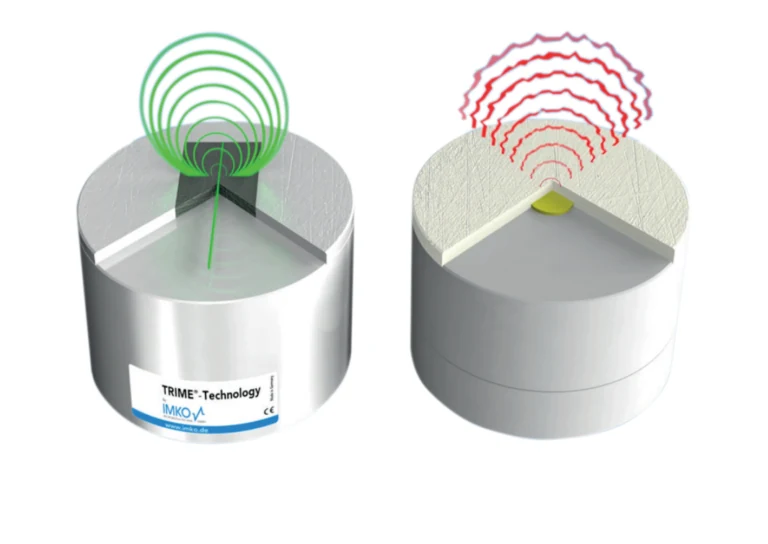
Field geometry, not accuracy specification, is what separates the two.
Where the two differ
Microwave moisture measurement is a mature, widely deployed technology and it works. The table below sets out the differences that matter operationally, using each manufacturer's published specifications rather than test claims.
| Consideration | TRIME TDR | Microwave | Why it matters |
|---|---|---|---|
| Measuring principle | Guided radar, transit time | Microwave absorption | Both dielectric. Different geometry. |
| Wear behaviour | Distance unchanged | Sensor dependent | Abrasive aggregate wears any face. |
| Recalibration on wear | Not required | Sensor dependent | Recalibration is downtime. |
| Head replacement | Replaceable on Xtrem | Sensor dependent | Rebuild cost vs replacement cost. |
| Portable option | Yes — HD2 handheld | Varies by supplier | Stockpile checks need a handheld. |
| Parameters | Moisture, temp, conductivity | Varies | Conductivity flags material change. |
Microwave column entries are marked "sensor dependent" where the behaviour varies between products and we will not generalise across a whole technology. Compare the specific datasheets for the two products you are actually choosing between.
How much material is the sensor reading?
Accuracy specs describe how precisely an instrument reports what it sees. They do not tell you how representative what it sees actually is.
A sand stockpile is not uniform. Material at the surface, near the walls or at the top of a bin can be wetter or drier than the bulk. A sensor reading a thin layer will report that layer very precisely. Whether that number describes the sand entering your mixer is a separate question — and it is the one that determines whether your water correction is right.
Ask for the measuring volume or penetration depth in the datasheet, not just the accuracy figure.
TDR vs microwave — frequently asked
Is TDR more accurate than microwave moisture measurement?
Headline accuracy figures are similar — both technologies are specified in the same range for aggregate work. The meaningful differences are elsewhere: how much material the sensor reads, whether the measuring geometry changes as the head wears, and whether the measurement passes through a protective cover.
Does probe wear affect a TDR reading?
No. With the TRIME TDR design the measuring distance stays constant despite abrasion on the probe surface, so measurement quality and accuracy are not affected by wear. Wear does not require recalibration.
What does 'measuring through a cover' mean?
In the SONO design the measuring conductor sits between two ceramic plates and is in direct contact with the material being measured — nothing is measured through the ceramic cover. That direct contact is what gives the probe its sensitivity.
Does grading curve variation affect the reading?
TRIME TDR measurement is specified as not sensitive to variations in the grading curve. That matters when your sand supplier changes or your stockpile segregates.
Send us the datasheet you are comparing against
We will go through it line by line with you — measuring volume, wear behaviour, output options — and tell you honestly where the other product is the better fit.
Houston, Texas · Most quotes answered within one business day