
SONO M1C Portable Probe for Conductive Materials
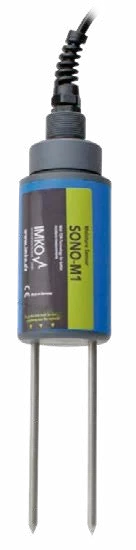
Coated-rod version of the M1 for high-conductivity materials that defeat standard probes.
- Coated rods handle conductive materials where uncoated probes lose resolution
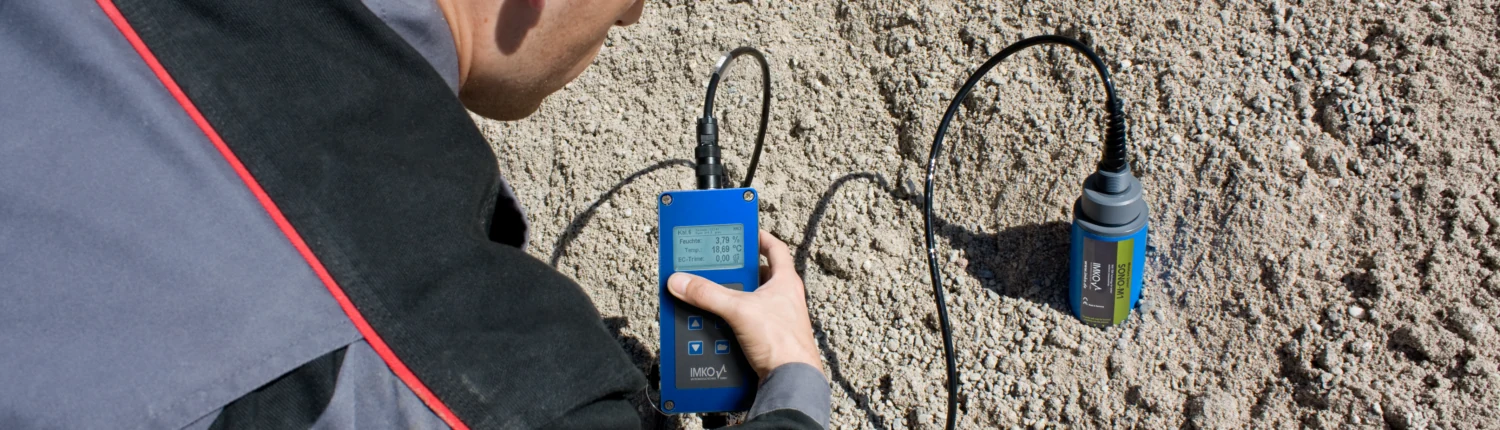
- Runs on the same HD2 display as SONO M1 and M2
- Standard choice for foundry return sand, slag and fly ash
The conductivity problem
Some materials conduct. Foundry return sand, blast furnace slag, fly ash, iron oxide, lime and lignite coal all carry enough ionic content to interfere with a dielectric moisture measurement, and a standard probe will either read erratically or not resolve at all.
This is not a calibration problem and no amount of recalibrating fixes it. It is a probe selection problem.
What the coating changes
The M1C carries coated rods, 100 mm long, on the same 64 mm body as the standard M1. The coating is what allows the measurement to work in conductive material.
There is a trade and it is worth stating plainly. SONO probes are differentiated per group in resolution and measuring range, and the higher the conductivity range a probe covers, the lower its resolution and accuracy. The M1C buys you the ability to measure material the M1 cannot, and it costs you some resolution to do it.
The practical rule follows directly: take the narrowest probe your material allows. If your sand is standard washed concrete sand, use the M1. Reach for the M1C when the material demands it, not as a general-purpose upgrade.
Where it earns its place
Foundries running green sand systems are the clearest case — moisture in the mixture typically runs 2 to 7 percent depending on the casting method, and it is one of the core parameters in a sand test alongside fineness, permeability and clay content.
Beyond foundry work, any plant handling slag, fly ash or lime as a constituent hits the same wall. Those materials are increasingly common in lower-carbon mix designs, which means more plants are running into conductivity limits than used to.
SONO M1C technical data
Materials: Clay sand, iron oxide, fly ash, blast furnace slag, lime, lignite coal
| Measurement technology | TRIME TDR |
|---|---|
| Probe diameter | 64 mm |
| Rod length | 100 mm, coated |
| Display | HD2 mobile display |
| Built for | High electrical conductivity materials |
SONO M1C — frequently asked
Why not just use the M1C for everything?
Because you would give up resolution for no reason. The higher the conductivity range a probe covers, the lower its resolution and accuracy. Standard sand and gravel read better on the M1.
Does it use the same display as the M1?
Yes. The HD2 mobile display runs the SONO M1, M1C and M2, so a plant measuring both standard and conductive material carries one display.
Why are the rods shorter than on the M1?
The M1C uses 100 mm coated rods against the M1's 130 mm uncoated rods. The geometry is part of how the probe handles conductive material.
Confirm the SONO M1C fits your material
Send your material, particle size and installation point. We will confirm the probe, the calibration and the output configuration before you order.
Houston, Texas · Most quotes answered within one business day